
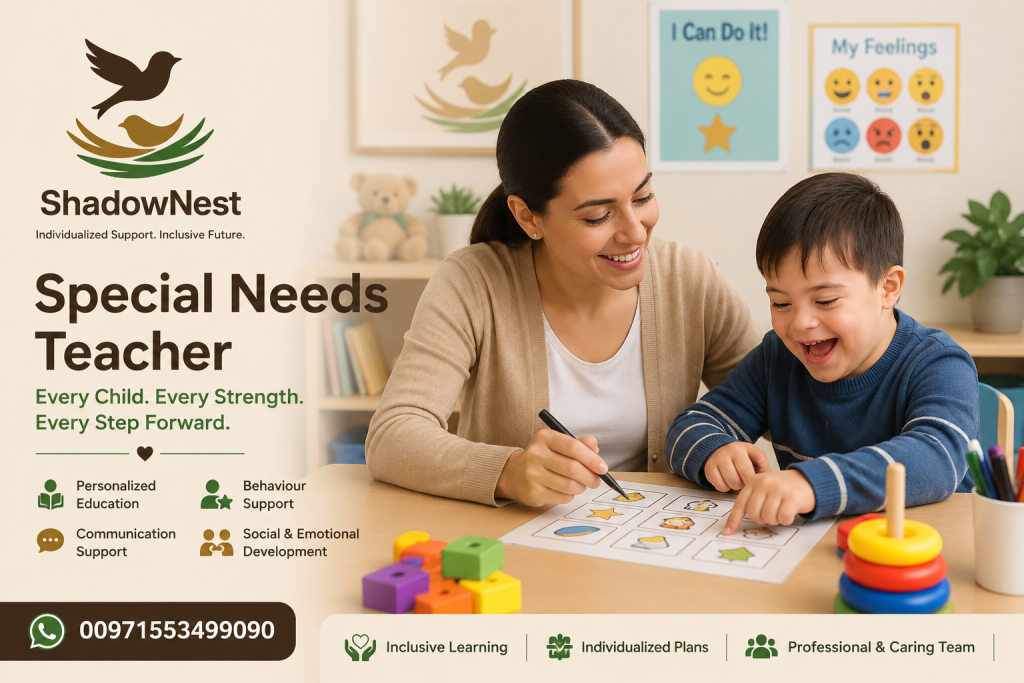
Special Needs Teacher: The Complete Guide for Parents and Schools
Table of Contents
- What Is a Special Needs Teacher?
- Why Special Needs Teachers Are Important
- Who Can Benefit from a Special Needs Teacher?
- Responsibilities of a Special Needs Teacher
- Skills Every Special Needs Teacher Should Have
- Special Needs Teacher vs Shadow Teacher
- Benefits for Children and Families
- How ShadowNest Supports Inclusive Education
- Frequently Asked Questions
- Conclusion
What Is a Special Needs Teacher?
A Special Needs Teacher plays one of the most important roles in helping children with diverse learning needs reach their full potential. Every child deserves an opportunity to succeed in school regardless of physical, cognitive, developmental, behavioural, or communication challenges.
Children with Autism Spectrum Disorder (ASD), ADHD, speech and language disorders, Down syndrome, learning disabilities, intellectual disabilities, sensory processing difficulties, and emotional challenges often require individualized educational strategies that go beyond traditional classroom teaching.
A professional Special Needs Teacher understands these unique learning profiles and adapts teaching methods accordingly. Instead of expecting every child to learn in the same way, they modify instruction, classroom activities, communication methods, and behavioural supports to match each child’s strengths and needs.
Today’s schools are becoming increasingly inclusive, allowing children with special educational needs to learn alongside their peers whenever possible. Inclusive education provides valuable opportunities for social interaction, communication, and confidence building, but it also requires skilled professionals who understand how to support children effectively.
This is where an experienced Special Needs Teacher becomes essential.
At ShadowNest, we believe every child deserves personalized educational support delivered by qualified professionals. Our team works closely with families, schools, therapists, and educational specialists to ensure children receive the guidance they need to succeed both academically and socially.
Why Is a Special Needs Teacher Important?
Education is not simply about reading, writing, or mathematics.
For many children, school is where they develop communication skills, emotional regulation, independence, problem-solving abilities, friendships, and self-confidence.
Children with special educational needs may experience challenges in one or more of these areas.
Without appropriate support, these challenges can affect:
- Academic achievement
- Classroom participation
- Social relationships
- Emotional wellbeing
- Confidence
- Independence
- Motivation to attend school
A professional Special Needs Teacher helps remove these barriers by creating an individualized learning approach based on each child’s abilities rather than their limitations.
Instead of focusing on what a child cannot do, special needs teachers identify strengths and use them to encourage continuous progress.
This positive, child-centred approach benefits not only academic performance but also long-term emotional and social development.
The Growing Need for Special Needs Teachers
Across the world, schools are recognizing the importance of inclusive education.
Dubai is no exception.
International schools throughout Dubai increasingly welcome children with diverse learning needs and actively promote inclusion within mainstream classrooms.
As awareness of neurodevelopmental conditions continues to grow, the demand for experienced Special Needs Teachers has also increased.
Parents today seek professionals who can support children with:
- Autism Spectrum Disorder (ASD)
- ADHD
- Speech and language disorders
- Learning disabilities
- Down syndrome
- Intellectual disabilities
- Developmental delay
- Emotional and behavioural challenges
- Sensory processing difficulties
A qualified Special Needs Teacher does much more than deliver lessons.
They become an important part of the child’s educational team, collaborating with classroom teachers, psychologists, speech therapists, occupational therapists, behaviour specialists, and parents to create consistent learning strategies.
What Does a Special Needs Teacher Do?
The responsibilities of a Special Needs Teacher extend far beyond traditional teaching.
Their role includes helping children participate confidently in classroom activities while developing academic, communication, behavioural, emotional, and social skills.
Daily responsibilities often include:
Individualized Learning Support
Every child learns differently.
A Special Needs Teacher adapts educational materials according to the child’s learning style, developmental level, and educational goals.
This may involve:
- Simplifying classroom instructions
- Breaking complex tasks into manageable steps
- Using visual supports
- Creating structured learning routines
- Providing individualized guidance
- Encouraging independent learning
The objective is to make learning accessible while gradually increasing independence.
Supporting Communication
Communication is essential for successful learning.
Many children experience difficulties understanding language, expressing ideas, asking questions, or participating in classroom discussions.
A professional Special Needs Teacher helps children strengthen both receptive and expressive communication skills through natural classroom interactions.
Support may include:
- Simplifying verbal instructions
- Expanding vocabulary
- Encouraging conversation
- Using visual communication systems
- Building confidence when speaking
- Supporting social communication
Strong communication skills improve both academic success and social participation.
Promoting Positive Behaviour
Behaviour often reflects a child’s communication, sensory, or emotional needs.
Rather than simply correcting behaviour, experienced Special Needs Teachers identify underlying causes and teach appropriate replacement skills.
Positive behaviour support may include:
- Understanding behavioural triggers
- Teaching emotional regulation
- Reinforcing positive choices
- Developing self-control
- Creating predictable routines
- Supporting classroom participation
These strategies help children become more confident, independent learners while creating a positive classroom environment.
Building Independence
Perhaps the most important goal of every Special Needs Teacher is helping children become increasingly independent.
Whether learning to organise school materials, complete assignments, communicate effectively, or solve problems independently, every small achievement contributes to long-term success.
Rather than creating dependence on adult assistance, effective teachers gradually reduce support as children gain confidence and develop new skills.
Who Can Benefit from a Special Needs Teacher?
Many parents believe that only children with severe disabilities need the support of a Special Needs Teacher. In reality, children with a wide variety of learning, developmental, behavioural, and communication needs can benefit from individualized educational support.
The purpose of a Special Needs Teacher is not to separate children from their classmates but to help them participate successfully in school while developing independence, confidence, and essential life skills.
Every child has unique strengths and challenges. An experienced Special Needs Teacher identifies these individual differences and designs strategies that allow each child to learn in the most effective way.
Below are some of the children who commonly benefit from the support of a professional Special Needs Teacher.
Children with Autism Spectrum Disorder (ASD)
Autism Spectrum Disorder affects communication, social interaction, emotional regulation, sensory processing, and behavioural flexibility.
Some children with autism have excellent academic abilities but struggle to participate in classroom routines. Others may require additional support with communication, peer interaction, or adapting to changes throughout the school day.
A professional Special Needs Teacher helps children with autism by:
- Creating structured daily routines.
- Using visual supports.
- Simplifying classroom instructions.
- Encouraging communication.
- Teaching social interaction skills.
- Supporting emotional regulation.
- Managing sensory challenges.
- Reinforcing positive behaviour.
Rather than completing tasks for the child, the teacher provides guidance that encourages increasing independence over time.
Children with Attention Deficit Hyperactivity Disorder (ADHD)
Children with ADHD often have strong intellectual abilities but experience difficulties with attention, organisation, impulse control, and executive functioning.
Without appropriate support, these challenges may affect academic performance, confidence, and relationships with teachers and classmates.
A qualified Special Needs Teacher helps children with ADHD by:
- Breaking large tasks into smaller steps.
- Using visual schedules.
- Improving organisational skills.
- Teaching time management.
- Encouraging self-monitoring.
- Reducing classroom distractions.
- Reinforcing positive behaviour.
- Increasing sustained attention.
These strategies help children become more successful learners while reducing frustration.
Children with Speech and Language Disorders
Communication difficulties can affect nearly every aspect of school life.
Children with speech and language disorders may struggle to:
- Understand classroom instructions.
- Express their ideas.
- Participate in discussions.
- Answer questions.
- Build friendships.
- Ask for help.
A Special Needs Teacher works closely with speech-language therapists and classroom teachers to reinforce communication strategies throughout the school day.
Support may include:
- Expanding vocabulary.
- Improving listening skills.
- Encouraging verbal interaction.
- Supporting expressive language.
- Strengthening social communication.
- Using visual communication tools when appropriate.
Consistent practice within natural classroom situations often leads to significant improvements.
Children with Learning Disabilities
Learning disabilities affect how children process information rather than how intelligent they are.
Many highly intelligent children require specialized teaching approaches to reach their academic potential.
A professional Special Needs Teacher supports children with:
- Dyslexia
- Dysgraphia
- Dyscalculia
- Non-verbal learning disorders
- Executive functioning difficulties
Support strategies include:
- Simplifying instructions.
- Teaching reading strategies.
- Supporting written expression.
- Improving mathematical understanding.
- Organising classroom materials.
- Developing study skills.
The emphasis is always on helping children become confident, independent learners.
Children with Down Syndrome
Children with Down syndrome often benefit from individualized educational support that considers both their cognitive strengths and developmental needs.
A Special Needs Teacher develops learning activities that encourage:
- Language development.
- Early literacy.
- Number concepts.
- Social interaction.
- Independence.
- Fine motor skills.
- Daily living skills.
Teaching is adapted to the child’s pace while maintaining high expectations and celebrating continuous progress.
Children with Intellectual Disabilities
Children with intellectual disabilities often require individualized teaching approaches that focus on functional learning, communication, and independence.
An experienced Special Needs Teacher creates realistic educational goals that help children develop practical skills for everyday life.
Support may include:
- Functional communication.
- Daily living skills.
- Social interaction.
- Classroom participation.
- Adaptive behaviour.
- Problem-solving.
- Self-care skills.
The goal is to maximise each child’s independence and quality of life.
Children with Emotional and Behavioural Challenges
Some children experience anxiety, emotional regulation difficulties, school refusal, aggression, or behavioural challenges that interfere with learning.
Rather than viewing behaviour as a problem, an experienced Special Needs Teacher understands that behaviour often communicates an unmet need.
Support focuses on:
- Identifying behavioural triggers.
- Teaching emotional regulation.
- Developing coping strategies.
- Improving classroom participation.
- Building confidence.
- Strengthening relationships with peers.
- Reinforcing positive behaviour.
Children who feel understood are more likely to engage positively in learning.
Children with Sensory Processing Difficulties
Some children experience sensory sensitivities that make classroom participation difficult.
They may become overwhelmed by:
- Loud sounds.
- Bright lights.
- Busy classrooms.
- Unexpected touch.
- Strong smells.
- Certain textures.
Others constantly seek movement or sensory input.
A Special Needs Teacher recognises these differences and develops classroom strategies such as:
- Visual schedules.
- Calm workspaces.
- Sensory breaks.
- Flexible seating.
- Movement activities.
- Predictable routines.
Meeting sensory needs allows children to focus more effectively on learning.
The Importance of Early Educational Support
Research consistently shows that early intervention leads to better educational outcomes.
When children receive support from an experienced Special Needs Teacher during their early school years, they often develop stronger communication skills, greater independence, improved behaviour, and increased confidence.
Early educational support also reduces frustration for families and teachers while helping children establish positive attitudes toward learning.
The earlier challenges are identified and addressed, the greater the opportunity for long-term success.
Inclusive Education Benefits Everyone
Inclusive classrooms do not only benefit children with additional needs.
All students learn valuable lessons about:
- Respect.
- Empathy.
- Cooperation.
- Diversity.
- Acceptance.
- Teamwork.
A skilled Special Needs Teacher helps create an environment where every child feels valued, respected, and capable of contributing to the classroom community.
Inclusive education prepares children for a diverse society by teaching understanding, kindness, and collaboration from an early age.
Benefits of Hiring a Special Needs Teacher
Choosing the right Special Needs Teacher can have a lasting impact on a child’s educational experience, emotional well-being, and future independence. While academic achievement is an important goal, the benefits of individualized educational support extend far beyond the classroom.
A qualified Special Needs Teacher helps children develop the confidence, resilience, communication skills, and problem-solving abilities they need to succeed throughout life.
Below are some of the most significant advantages of working with an experienced Special Needs Teacher.
Improved Academic Achievement
Every child learns differently.
Traditional teaching methods may not always meet the needs of children with learning differences or developmental challenges.
A Special Needs Teacher adapts instruction so children can understand new concepts more effectively.
Academic support often includes:
- Individualized lesson planning.
- Modified teaching strategies.
- Visual learning materials.
- Multi-sensory instruction.
- Step-by-step guidance.
- Regular progress monitoring.
As learning becomes more accessible, children often demonstrate greater confidence and improved academic performance.
Increased Independence
One of the primary goals of every Special Needs Teacher is helping children become independent learners.
Rather than encouraging dependence on adults, professional teachers gradually reduce support as children develop new skills.
Children learn to:
- Complete classroom tasks independently.
- Organize school materials.
- Make appropriate decisions.
- Solve everyday problems.
- Follow routines.
- Take responsibility for their own learning.
These life skills remain valuable long after formal education has ended.
Better Communication Skills
Communication affects every area of a child’s life.
A Special Needs Teacher creates daily opportunities for children to practice:
- Expressing ideas.
- Asking questions.
- Understanding instructions.
- Participating in discussions.
- Developing vocabulary.
- Improving social communication.
Children who communicate more effectively often develop stronger relationships with teachers, classmates, and family members.
Stronger Social Skills
Friendships are an essential part of healthy childhood development.
Many children with special educational needs require guidance to understand social expectations and build positive relationships.
A Special Needs Teacher encourages children to:
- Join group activities.
- Work cooperatively.
- Share with classmates.
- Take turns.
- Resolve conflicts peacefully.
- Build meaningful friendships.
Social confidence often improves alongside academic success.
Greater Emotional Confidence
Children who repeatedly experience academic or social difficulties may begin to lose confidence in their abilities.
A supportive Special Needs Teacher creates an environment where effort is recognized, progress is celebrated, and mistakes become opportunities for learning.
As confidence grows, children become more willing to:
- Try new activities.
- Participate in class.
- Ask for help.
- Solve problems independently.
- Develop resilience after setbacks.
Positive emotional development supports lifelong learning.
Parent and School Collaboration
Successful education depends on teamwork.
The most effective Special Needs Teacher works collaboratively with everyone involved in the child’s education.
This team often includes:
- Parents
- Classroom teachers
- School leadership
- Speech-language therapists
- Occupational therapists
- Psychologists
- Behaviour specialists
Regular communication ensures educational goals remain consistent across all environments.
Parents play an important role by:
- Sharing observations from home.
- Reinforcing learning strategies.
- Encouraging independence.
- Celebrating progress.
- Communicating concerns early.
When schools and families work together, children receive consistent guidance that supports long-term success.
How to Choose the Right Special Needs Teacher
Selecting the right Special Needs Teacher requires careful consideration.
Parents should look beyond qualifications alone and consider the teacher’s experience, communication style, and ability to build positive relationships with children.
Important qualities include:
Professional Experience
Look for teachers who have experience supporting children with needs similar to your child’s profile.
Experience with autism, ADHD, speech disorders, learning disabilities, behavioural challenges, or intellectual disabilities can make a significant difference.
Individualized Teaching Approach
Every child learns differently.
An excellent Special Needs Teacher adapts teaching methods instead of expecting children to fit a standard educational model.
Teaching should always be flexible and child-centred.
Communication with Families
Parents should receive regular updates regarding:
- Academic progress.
- Behaviour.
- Communication.
- Social development.
- Educational goals.
- Recommendations for home support.
Open communication strengthens the partnership between home and school.
Commitment to Professional Development
Educational research continues to evolve.
Outstanding Special Needs Teachers regularly participate in:
- Professional training.
- Educational workshops.
- Research updates.
- Continuing education.
- Collaboration with multidisciplinary teams.
Continuous learning benefits both teachers and students.
Common Mistakes Parents Should Avoid
Parents naturally want the best for their children.
However, certain misconceptions may unintentionally slow educational progress.
Expecting Immediate Results
Meaningful development takes time.
Small improvements often lead to significant long-term success.
Consistency is more important than rapid progress.
Comparing Children
Every child develops at their own pace.
Comparing one child’s progress with another’s can create unnecessary pressure and reduce confidence.
Educational goals should always remain individualized.
Focusing Only on Academic Performance
Education involves much more than grades.
A Special Needs Teacher also helps children develop:
- Independence.
- Communication.
- Emotional regulation.
- Social skills.
- Problem-solving.
- Confidence.
These abilities often influence future success more than academic achievement alone.
Why Families Choose ShadowNest
At ShadowNest, we understand that every child deserves individualized educational support delivered with professionalism, compassion, and respect.
Our experienced Special Needs Teachers collaborate closely with families, schools, speech therapists, psychologists, occupational therapists, and other educational professionals to create personalized learning plans that support every aspect of a child’s development.
We focus on:
- Individualized education.
- Inclusive learning.
- Evidence-based teaching.
- Parent collaboration.
- School partnerships.
- Communication development.
- Behaviour support.
- Independence.
- Academic success.
Our goal is to help every child reach their full potential while giving parents confidence that their child is receiving high-quality educational support.
Case Example
A seven-year-old student entered a mainstream school with difficulties in communication, classroom participation, and emotional regulation.
Following an individualized educational program developed by a Special Needs Teacher, the child gradually improved classroom engagement, developed stronger communication skills, participated in group activities, and completed classroom assignments with increasing independence.
This example illustrates how consistent educational support, collaboration with families, and evidence-based teaching strategies can significantly improve a child’s school experience.
Frequently Asked Questions About Special Needs Teachers
1. What is a Special Needs Teacher?
A Special Needs Teacher is a qualified education professional who supports children with developmental, learning, behavioural, communication, or physical challenges. They adapt teaching methods, create individualized learning plans, and help children achieve academic, social, and emotional success.
2. Who needs a Special Needs Teacher?
Children with Autism Spectrum Disorder (ASD), ADHD, speech and language disorders, learning disabilities, Down syndrome, intellectual disabilities, developmental delays, sensory processing difficulties, and emotional or behavioural challenges may benefit from working with a Special Needs Teacher.
3. Is a Special Needs Teacher different from a Shadow Teacher?
Yes.
A Special Needs Teacher focuses on educational assessment, curriculum adaptation, individualized instruction, and long-term learning goals.
A Shadow Teacher provides one-to-one classroom support that helps children participate successfully in school while encouraging independence.
Although their responsibilities differ, they often work together.
4. Can a Special Needs Teacher work in mainstream schools?
Yes.
Many mainstream schools provide inclusive education and work closely with Special Needs Teachers to ensure children receive appropriate educational support while learning alongside their peers.
5. Does every child with autism need a Special Needs Teacher?
Not necessarily.
The decision depends on the child’s communication abilities, independence, learning profile, classroom participation, and educational goals rather than the diagnosis alone.
6. What qualifications should a Special Needs Teacher have?
Parents should look for professionals with:
- Educational qualifications.
- Experience supporting children with special educational needs.
- Knowledge of inclusive education.
- Strong communication skills.
- Positive behaviour support experience.
- Child-centred teaching approaches.
7. How does a Special Needs Teacher support communication?
They encourage classroom participation, strengthen vocabulary, improve listening skills, support expressive language, teach social communication, and collaborate with speech-language therapists when needed.
8. Can a Special Needs Teacher improve behaviour?
Yes.
Rather than simply managing behaviour, a Special Needs Teacher identifies underlying causes, teaches replacement skills, reinforces positive behaviour, and helps children develop emotional regulation.
9. How often should a child work with a Special Needs Teacher?
The amount of support depends on the child’s educational needs. Some children require daily assistance, while others benefit from periodic intervention or consultation.
10. What is the main goal of a Special Needs Teacher?
The ultimate goal is helping children become confident, independent learners who can participate successfully in school and everyday life.
Why Choose ShadowNest?
Finding the right Special Needs Teacher is one of the most important decisions parents can make.
At ShadowNest, we connect families with experienced educational professionals who understand that every child learns differently. Our specialists work collaboratively with parents, schools, psychologists, speech-language therapists, occupational therapists, and other professionals to provide individualized educational support based on each child’s strengths, abilities, and goals.
Our approach focuses on:
- Individualized education plans.
- Evidence-based teaching strategies.
- Inclusive education.
- Academic success.
- Communication development.
- Social participation.
- Emotional wellbeing.
- Behaviour support.
- Building lifelong independence.
Whether your child requires short-term educational assistance or ongoing support, ShadowNest is committed to helping every child reach their full potential in a safe, encouraging, and inclusive learning environment.
Conclusion
A Special Needs Teacher plays a vital role in helping children overcome educational barriers while building confidence, independence, communication skills, and academic success.
Every child deserves the opportunity to learn in an environment where they feel respected, understood, and supported. Through individualized teaching, collaboration with families and schools, and evidence-based educational strategies, Special Needs Teachers help children develop the skills they need for lifelong learning and personal growth.
As inclusive education continues to expand across Dubai and the UAE, the demand for qualified Special Needs Teachers continues to grow. Choosing the right professional can make a meaningful difference not only in a child’s academic progress but also in their emotional wellbeing, social development, and future independence.
At ShadowNest, we are proud to support families by connecting them with experienced and compassionate Special Needs Teachers who are dedicated to helping every child thrive. Our commitment to personalized education, collaboration, and professional excellence ensures that children receive the support they need to succeed both inside and outside the classroom.
If you are looking for a trusted Special Needs Teacher in Dubai or the UAE, contact ShadowNest today and discover how individualized educational support can transform your child’s learning journey.
Real Science, Real Impact
For a deeper understanding of autism, speech-language therapy, and school-based intervention, explore these peer-reviewed articles by Dr. Azizreza Ghasemzadeh:
🔗 Cultural Considerations in the Assessment and Intervention for Autism Disorder
🔗 The Role of Speech Therapy in Enhancing Communication Skills of Children with Exceptional Needs
🔗 Psychosomatic Manifestations in Speech and Language Disorders: A Comprehensive Review
This peer-reviewed paper highlights how cultural awareness and shadow teaching complement each other, especially in diverse communities like Dubai.
Related Topics:
Classroom Support by ShadowNest
Inclusive Education by ShadowNest
shadow teacher in Dubai school
Does my 2 years old need Speech therapy?
How to Request the Best Shadow Teacher in Dubai
If you’re a parent or school administrator seeking expert support, ShadowNest makes the process simple.
👉 Click here to request a Shadow Teacher
Together, we’ll design a support system that works for your child’s unique needs.