
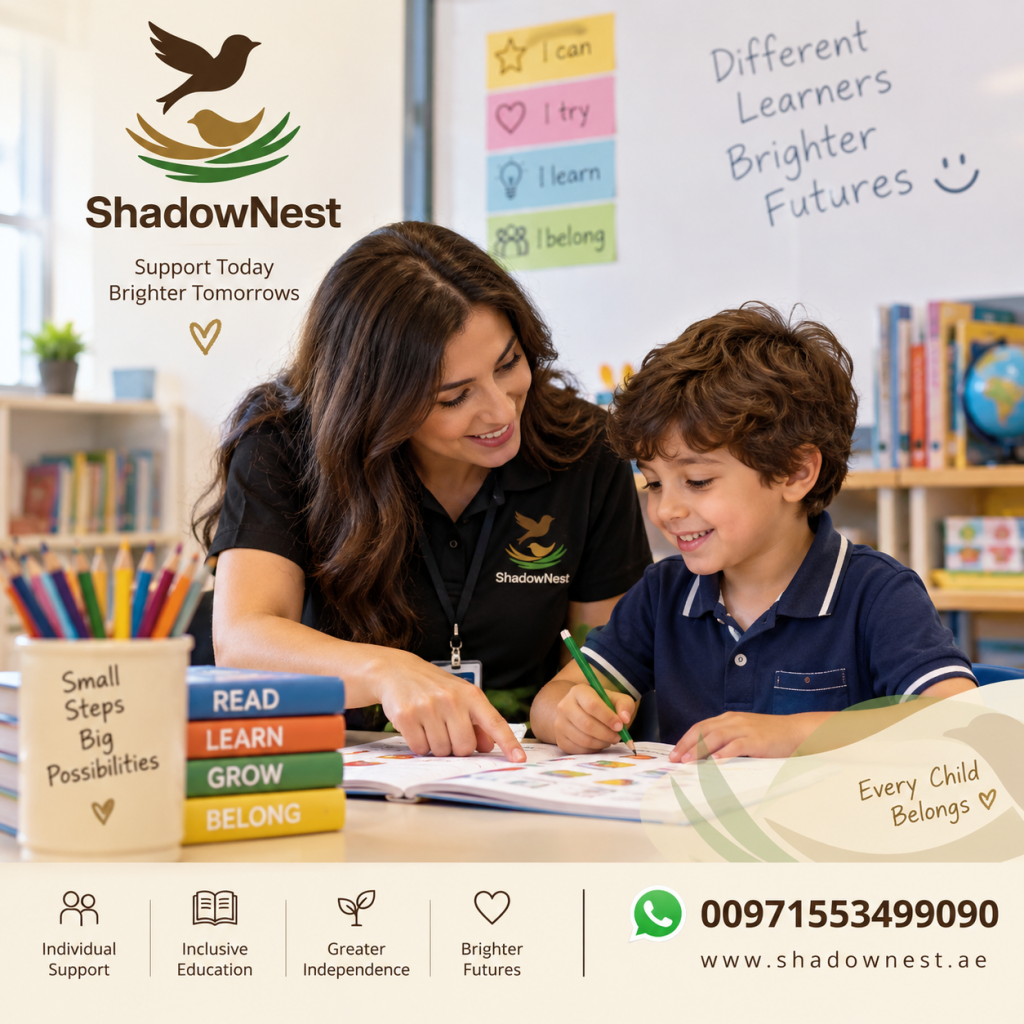
Inclusion is more than allowing every child to enter a classroom. It is about creating a school environment where every child feels valued, supported, respected, and able to participate.
Every child learns differently. Some children may learn quickly through traditional teaching methods, while others may need additional time, visual support, movement breaks, communication assistance, behavioral support, or individualized strategies. Children with autism, ADHD, learning difficulties, speech and language delays, developmental differences, or other special educational needs may require additional support to participate successfully in everyday school life.
This is where Inclusion becomes especially important.
UNESCO describes inclusion in education as a process of identifying and removing barriers that prevent learners from participating in education. This includes barriers related to teaching, curriculum, school environments, communication, and participation.
UNICEF similarly emphasizes that children with disabilities have the same right to quality education and that inclusive education can provide meaningful opportunities for children to learn and develop alongside their peers.
But what does Inclusion actually look like inside a school?
How can teachers, parents, schools, and support professionals create classrooms where children with different abilities can learn together?
And how can a shadow teacher contribute to this process without making a child unnecessarily dependent on adult support?
In this article, we explore 10 powerful ways to promote Inclusion at school and help every child participate, learn, communicate, and develop greater independence.
What Does Inclusion Mean in Education?
At its simplest, Inclusion means making sure that every learner has a genuine opportunity to participate in education.
However, inclusion is not simply about putting children in the same classroom.
A child can physically attend a mainstream classroom and still experience exclusion.
For example, a child might:
- Sit separately from classmates.
- Struggle to understand classroom instructions.
- Have no opportunity to participate in group activities.
- Be excluded from playground games.
- Have difficulty communicating with teachers.
- Experience bullying because of differences.
- Receive work that is consistently inappropriate for their developmental level.
- Depend completely on an adult without being taught independence.
True Inclusion looks beyond physical presence.
It asks:
Can the child participate?
Can the child communicate?
Can the child learn?
Can the child build friendships?
Can the child develop independence?
Does the child feel that they belong?
UNESCO emphasizes that inclusive education should address barriers to participation rather than expecting every learner to fit into a single educational model.
This is an important change in perspective.
Instead of asking:
“Why can’t this child adapt to the classroom?”
we can ask:
“What can we change about the environment, teaching approach, communication, or support system to help this child participate?”
That shift is at the heart of Inclusion.
1. Build a Classroom Culture of Belonging
The first step toward Inclusion is creating a classroom where every child feels that they belong.
Children should not feel that they are “the different child” in the classroom.
They should feel like members of the class.
This can be encouraged through simple daily practices.
Teachers can:
- Use inclusive language.
- Encourage cooperative activities.
- Celebrate individual strengths.
- Give every child opportunities to contribute.
- Avoid unnecessary comparisons.
- Encourage peer support.
- Teach children about differences and empathy.
- Create predictable classroom routines.
For example, instead of always assigning a child with additional needs a separate task, teachers can modify a group activity so that the child can participate with classmates.
A child with communication difficulties might contribute by choosing pictures.
A child with motor difficulties might take responsibility for another part of the activity.
A child with ADHD might participate through a movement-based role.
A child with autism might benefit from visual instructions or a predictable sequence of activities.
The goal is not to make every child behave in exactly the same way.
The goal is to create meaningful participation.
That is the foundation of Inclusion.
2. Understand Individual Learning Needs
Every child is different.
Even two children with the same diagnosis may have completely different strengths and challenges.
For example, two children with ADHD may both experience attention difficulties, but one may need movement breaks while the other may benefit more from visual organization.
Two children with autism may have very different communication profiles.
One child may speak fluently but struggle with social communication.
Another may have limited verbal communication and require visual communication support.
This is why effective Inclusion should not be based only on diagnostic labels.
Instead, schools should understand the individual child.
Important questions include:
- What does the child do well?
- What situations are difficult?
- How does the child communicate?
- What helps the child stay engaged?
- What triggers frustration?
- What motivates the child?
- What sensory needs should be considered?
- What level of independence can the child achieve?
- What classroom adaptations are helpful?
Understanding the individual learner allows teachers and support professionals to create more effective strategies.
UNICEF notes that inclusive education requires education systems to respond to diverse needs rather than treating all learners as though they have identical requirements.
3. Adapt Teaching Without Lowering Expectations
One common misunderstanding about Inclusion is that adapting education means making the curriculum easier.
That is not necessarily true.
Adaptation means changing how a child accesses learning.
The learning goal may remain meaningful and challenging while the method of teaching changes.
For example, a teacher might:
- Use pictures alongside spoken instructions.
- Break a large task into smaller steps.
- Provide additional processing time.
- Use hands-on materials.
- Repeat important information.
- Provide written instructions.
- Use visual schedules.
- Allow alternative ways of demonstrating knowledge.
Consider a child who has difficulty writing.
Instead of assuming that the child does not understand the lesson, the teacher might allow the child to answer orally, use technology, select answers, or demonstrate understanding in another appropriate way.
The objective is to remove unnecessary barriers while maintaining meaningful learning expectations.
This approach supports Inclusion because it recognizes that equal opportunity does not always mean giving every child exactly the same thing.
Sometimes fairness requires different forms of support.
4. Strengthen Communication Between School and Family
Successful Inclusion requires collaboration.
Teachers cannot do everything alone.
Parents cannot do everything alone.
Shadow teachers cannot do everything alone.
Therapists cannot do everything alone.
The most effective support usually comes from communication between the people who understand different parts of the child’s life.
Parents may know:
- The child’s communication style.
- Their interests.
- Their fears.
- Their routines.
- What works at home.
- What situations commonly trigger distress.
Teachers understand:
- Classroom expectations.
- Academic demands.
- Peer relationships.
- School routines.
- Group learning.
Speech therapists and other professionals may understand:
- Communication needs.
- Language development.
- Social communication.
- Functional communication strategies.
A shadow teacher may observe how the child functions throughout the school day and provide individualized classroom support.
When these perspectives are shared appropriately, the child receives more consistent support.
Communication should not only happen when there is a problem.
Regular communication can help identify progress early and prevent small challenges from becoming major barriers.
5. Use Shadow Teachers to Support Independence
A shadow teacher can play an important role in Inclusion, particularly for children who need individualized assistance to participate successfully in mainstream school environments.
However, the goal of a shadow teacher should not be to stay next to the child forever.
The ultimate goal should be greater participation and independence.
A shadow teacher may initially provide significant support with:
- Classroom routines.
- Following instructions.
- Transitions.
- Communication.
- Social interaction.
- Emotional regulation.
- Task organization.
- Attention.
- Participation in group activities.
But effective support should gradually encourage the child to do more independently whenever possible.
For example, instead of immediately answering a child’s question, the shadow teacher might provide a prompt that encourages the child to respond independently.
Instead of completing an activity for the child, the shadow teacher can break it into manageable steps.
Instead of always speaking for a child, the shadow teacher can create opportunities for the child to communicate directly with teachers and classmates.
This is an important principle of Inclusion.
Support should open doors rather than create another barrier.
6. Encourage Peer Relationships
Academic participation is only one part of Inclusion.
Children also need opportunities to build friendships.
For many children with special educational needs, social participation can be more difficult than academic participation.
They may struggle with:
- Starting conversations.
- Understanding social cues.
- Joining games.
- Taking turns.
- Understanding personal space.
- Managing disagreements.
- Understanding jokes or figurative language.
- Maintaining conversations.
Schools can support social inclusion by creating structured opportunities for interaction.
For example:
Cooperative learning
Students can work together toward a shared goal.
Peer buddy systems
A classmate can help another child participate in specific activities.
Structured playground activities
Teachers can organize games with clear rules and predictable turns.
Group projects
Children can contribute different strengths to a shared task.
Social communication activities
Children can practice greetings, requesting, commenting, asking questions, and problem-solving.
The objective is not simply to make children “social.”
The objective is to create genuine opportunities for relationships.
Children should have opportunities to experience friendship, cooperation, humor, play, and belonging.
That is an essential part of Inclusion.
7. Create Predictable Routines
Predictability can make a major difference for children who struggle with transitions, attention, anxiety, or regulation.
A predictable school environment can help children understand:
- What is happening now.
- What will happen next.
- When an activity will end.
- Where they need to go.
- What is expected from them.
Visual schedules can be particularly helpful.
For example:
Morning Arrival → Circle Time → Math → Break → Reading → Lunch → Playground → Art → Home
A child can see the sequence rather than relying entirely on spoken instructions.
Teachers can also provide advance warnings before transitions.
For example:
“In five minutes, we will finish this activity and go to the playground.”
Then:
“Two more minutes.”
Then:
“One more minute.”
Then:
“It’s time to finish.”
These strategies can support Inclusion because they reduce unnecessary barriers to participation.
8. Support Emotional Regulation
A child cannot always learn effectively when overwhelmed.
Children may become distressed because of:
- Sensory overload.
- Communication difficulties.
- Unexpected changes.
- Difficult academic tasks.
- Social conflicts.
- Fatigue.
- Frustration.
- Anxiety.
- Difficulty expressing needs.
Rather than viewing every challenging behavior as deliberate misbehavior, adults should ask:
What is the child communicating through this behavior?
For example, a child who throws materials may be communicating:
“This task is too difficult.”
A child who leaves the classroom may be communicating:
“I need a break.”
A child who refuses to participate may be communicating:
“I don’t understand what you want me to do.”
A child who becomes aggressive may be communicating distress when they do not yet have an effective communication strategy.
This does not mean that unsafe behavior should be ignored.
Instead, schools can combine appropriate boundaries with supportive strategies.
A child may benefit from:
- Calm-down strategies.
- Visual emotion scales.
- Break cards.
- Quiet spaces.
- Sensory supports.
- Functional communication.
- Predictable routines.
- Positive reinforcement.
- Teaching replacement behaviors.
Supporting regulation helps children remain connected to the learning environment.
That makes Inclusion more realistic and sustainable.
9. Make the Classroom Accessible
Accessibility is another important part of Inclusion.
When people hear the word accessibility, they may immediately think about physical access.
Physical accessibility is important, but educational accessibility goes much further.
A classroom should consider:
Physical accessibility
Can the child safely move around the environment?
Communication accessibility
Can the child understand instructions and express needs?
Sensory accessibility
Is the environment excessively noisy, bright, crowded, or overwhelming?
Academic accessibility
Can the child access the curriculum using appropriate support?
Social accessibility
Does the child have genuine opportunities to interact with peers?
Emotional accessibility
Does the child feel safe enough to participate?
UNESCO emphasizes that inclusive education involves identifying barriers across education systems, including curriculum and teaching practices.
This means that Inclusion is not simply about a child’s diagnosis.
It is also about the environment around the child.
10. Measure Progress Beyond Grades
Academic grades are important, but they are not the only measure of successful Inclusion.
For some children, progress may initially appear in other areas.
For example:
- The child enters the classroom independently.
- The child follows a visual schedule.
- The child asks for help.
- The child joins a group activity.
- The child initiates communication.
- The child remains engaged for longer.
- The child tolerates transitions better.
- The child plays with peers.
- The child completes part of a task independently.
These achievements can represent significant developmental progress.
A good support plan should therefore consider multiple areas of functioning.
Schools and families can monitor:
Academic progress
Communication
Social participation
Emotional regulation
Behavior
Independence
Self-advocacy
Classroom participation
Peer relationships
This broader perspective helps schools understand whether Inclusion is actually working for the individual child.
Why Inclusion Matters for Children With Special Educational Needs
Children with disabilities and developmental differences can face significant barriers to education.
UNICEF identifies discrimination, stigma, lack of trained teachers, inadequate learning materials, and inaccessible environments among the barriers that can affect educational participation for children with disabilities.
This is why Inclusion should not be viewed as an optional educational trend.
It is connected to participation, learning, social development, and children’s rights.
A child should not have to become exactly like everyone else before being allowed to participate.
Instead, educational environments should become flexible enough to accommodate meaningful differences.
This does not mean lowering standards.
It means providing appropriate pathways toward learning.
Inclusion and Autism
Children with autism may have a wide range of strengths and support needs.
Some children may require support with:
- Social communication.
- Flexible thinking.
- Transitions.
- Sensory regulation.
- Classroom routines.
- Group participation.
- Understanding social expectations.
- Functional communication.
A supportive classroom can use visual schedules, clear routines, predictable instructions, structured peer activities, and individualized communication strategies.
A shadow teacher may help the child understand classroom expectations while gradually encouraging independent participation.
Importantly, Inclusion should not mean forcing autistic children to hide their differences.
The goal should be meaningful participation, communication, safety, learning, and independence.
Inclusion and ADHD
Children with ADHD may experience difficulties with:
- Sustained attention.
- Impulse control.
- Organization.
- Working memory.
- Time management.
- Sitting for extended periods.
- Completing multi-step tasks.
These difficulties do not mean that a child is incapable of learning.
The classroom may simply need appropriate strategies.
Examples include:
- Shorter task segments.
- Visual instructions.
- Movement breaks.
- Clear expectations.
- Organizational systems.
- Positive reinforcement.
- Reduced distractions.
- Opportunities for active participation.
A shadow teacher can support the child while coordinating with teachers so that strategies become part of the classroom routine rather than making the child completely dependent on one adult.
This supports sustainable Inclusion.
Inclusion and Learning Difficulties
Children with dyslexia, developmental language disorder, or other learning difficulties may understand concepts but struggle to demonstrate their knowledge using conventional methods.
For example, a child may understand a story when listening but struggle to read it independently.
Another child may understand mathematics but have difficulty interpreting written instructions.
Another may have strong ideas but struggle to express them in writing.
Effective Inclusion requires educators to distinguish between:
What the child knows
and
How the child is currently able to demonstrate what they know.
Appropriate accommodations and teaching strategies can help reduce unnecessary barriers.
This does not mean that children should avoid developing difficult skills.
Instead, support should help them develop those skills while maintaining access to meaningful learning.
The Role of Teachers in Inclusion
Teachers are central to successful Inclusion.
Teachers can help by:
- Building an accepting classroom culture.
- Understanding individual differences.
- Differentiating instruction.
- Collaborating with families.
- Working with support professionals.
- Encouraging peer relationships.
- Monitoring progress.
- Promoting independence.
- Addressing bullying and exclusion.
- Celebrating different strengths.
Teachers do not need to become experts in every disability.
They do, however, need access to appropriate support, training, collaboration, and resources.
UNESCO has highlighted teacher preparation and support as important components of effective inclusive education systems.
The Role of Parents in Inclusion
Parents are essential partners.
They can provide valuable information about their child’s:
- Communication.
- Interests.
- Strengths.
- Challenges.
- Routines.
- Sensory preferences.
- Emotional needs.
- Previous interventions.
Parents can also help reinforce useful strategies at home.
However, parents should not feel that they are solely responsible for making Inclusion successful.
Inclusion works best when families and schools share responsibility and communicate regularly.
The Role of a Shadow Teacher in Inclusion
A shadow teacher can serve as a bridge between the child’s needs and the classroom environment.
Depending on the child’s individual needs, a shadow teacher may support:
- Classroom participation.
- Communication.
- Attention.
- Transitions.
- Social interaction.
- Emotional regulation.
- Task completion.
- Organization.
- Following classroom routines.
- Independence.
But the most effective shadow teacher does not simply follow the child and provide answers all day.
Instead, the support should be purposeful.
The shadow teacher can gradually reduce prompts when the child develops the ability to complete tasks independently.
For example:
Full assistance → verbal prompt → visual prompt → gesture → independent response
This gradual reduction of support can help prevent unnecessary dependence.
At ShadowNest, the philosophy behind shadow teacher support is closely connected to helping children participate meaningfully in school while developing their abilities and independence.
Inclusion Does Not Mean the Same Thing for Every Child
One of the most important principles of Inclusion is that there is no single strategy that works for everyone.
A child may need:
- Minimal classroom adjustments.
Another child may need:
- Regular learning support.
Another may need:
- One-to-one shadow teacher assistance.
Another may need:
- Speech and language therapy.
Another may need:
- Occupational therapy.
Another may need:
- Behavioral and emotional support.
Some children may need several forms of support at different stages of development.
Therefore, schools should avoid one-size-fits-all solutions.
Instead, support should be individualized, reviewed regularly, and adjusted according to progress.
How Schools Can Create a More Inclusive Environment
Schools can take practical steps to strengthen Inclusion.
1. Train staff
Teachers and school staff should understand different learning profiles and inclusive teaching strategies.
2. Develop individualized support plans
Plans should identify strengths, challenges, goals, and practical strategies.
3. Encourage collaboration
Teachers, parents, therapists, learning support teams, and shadow teachers should communicate.
4. Monitor participation
Schools should look beyond grades and examine whether children participate socially and academically.
5. Promote peer understanding
Children can be taught about empathy, differences, cooperation, and respect.
6. Address bullying quickly
No child can experience meaningful Inclusion while being consistently bullied or excluded.
7. Promote independence
Support should gradually move toward helping children become more independent.
8. Adapt the environment
Small changes can sometimes make a significant difference.
9. Listen to the child
Whenever developmentally appropriate, children should have a voice in decisions affecting their education.
10. Review strategies regularly
What works today may not be necessary six months later.
10 Powerful Ways to Promote Inclusion
Let’s summarize the key strategies discussed in this article.
1. Create belonging
Make every child feel like a valued member of the classroom.
2. Understand individual needs
Look beyond diagnosis and understand the whole child.
3. Adapt teaching
Modify methods and materials without unnecessarily lowering expectations.
4. Strengthen communication
Create strong partnerships between families, schools, and professionals.
5. Use shadow teachers strategically
Provide individualized support while working toward independence.
6. Build peer relationships
Give children meaningful opportunities to develop friendships.
7. Create predictable routines
Visual schedules and clear expectations can reduce barriers.
8. Support emotional regulation
Teach children appropriate ways to communicate needs and manage challenges.
9. Improve accessibility
Consider physical, academic, communication, sensory, social, and emotional accessibility.
10. Measure meaningful progress
Look beyond grades and consider participation, communication, independence, and social development.
Inclusion Is About Belonging, Not Just Attendance
A child being physically present in a classroom does not automatically mean that the child is included.
True Inclusion asks whether the child is participating.
Can they communicate?
Can they learn?
Can they interact?
Can they make choices?
Can they develop friendships?
Can they become more independent?
Can they feel proud of their achievements?
These questions change the way schools think about support.
Instead of asking how we can make every child fit into the same educational model, we begin asking how the educational environment can become more flexible and responsive.
This is a more meaningful approach to education.
How ShadowNest Supports Inclusion
At ShadowNest, we believe every child deserves the opportunity to participate in school, develop their abilities, and experience a genuine sense of belonging.
A shadow teacher can provide individualized support for children who may need additional assistance during the school day.
Support may include classroom participation, communication, social interaction, attention, transitions, emotional regulation, and daily routines.
The goal is not simply to have an adult beside a child.
The goal is to help the child participate, learn, communicate, and become increasingly independent.
For families looking for additional school support, choosing the right shadow teacher can be an important step toward creating a more successful and inclusive educational experience.
You can learn more about Shadow Teacher in Dubai and the support available through ShadowNest on our website.
Frequently Asked Questions About Inclusion
What is Inclusion in education?
Inclusion in education means creating learning environments where all students can participate meaningfully, regardless of their abilities, backgrounds, or individual learning needs. It involves identifying and reducing barriers to participation and learning.
Is Inclusion only for children with disabilities?
No.
Inclusion applies to all learners who may experience barriers to education, including children with disabilities, language differences, learning difficulties, social challenges, and other individual needs. UNESCO describes inclusion broadly as identifying and removing barriers to education.
Does Inclusion mean every child receives exactly the same support?
No.
Equality does not always mean identical support.
Some children may need additional resources, accommodations, or individualized assistance to have a meaningful opportunity to participate.
Can a shadow teacher support Inclusion?
Yes.
A shadow teacher can provide individualized assistance that helps a child participate in classroom activities, communicate, follow routines, interact with peers, and develop independence.
Does a shadow teacher make a child dependent?
Not necessarily.
The quality and purpose of support are important. Effective support should encourage independence and gradually reduce unnecessary prompts whenever appropriate.
Why is peer interaction important?
Education is not only about academic achievement.
Children also develop communication, social skills, cooperation, emotional understanding, and relationships through interaction with peers.
How can parents support Inclusion?
Parents can communicate with teachers, share information about their child’s strengths and needs, participate in planning, reinforce useful strategies at home, and advocate for appropriate educational support.
Final Thoughts
Inclusion is not simply a policy, a classroom arrangement, or a support service.
It is a way of thinking about education.
It starts with the belief that every child has value and potential.
It recognizes that children learn differently.
It understands that barriers can exist within environments, teaching methods, communication systems, and social expectations.
And most importantly, it asks schools and communities to create opportunities rather than limitations.
UNICEF’s current global work on inclusive education emphasizes that exclusion is not inevitable and that education systems can become more responsive when they recognize learners’ needs and invest in appropriate support.
For children with special educational needs, the journey toward successful Inclusion may require teachers, parents, therapists, learning support professionals, and shadow teachers to work together.
When that happens, the goal is not merely for a child to attend school.
The goal is for the child to belong.
To participate.
To learn.
To communicate.
To build relationships.
And ultimately, to become as independent and confident as possible.
That is what meaningful Inclusion can look like.
Real Science, Real Impact
For a deeper understanding of autism, speech-language therapy, and school-based intervention, explore these peer-reviewed articles by Dr. Azizreza Ghasemzadeh:
🔗 Cultural Considerations in the Assessment and Intervention for Autism Disorder
🔗 The Role of Speech Therapy in Enhancing Communication Skills of Children with Exceptional Needs
🔗 Psychosomatic Manifestations in Speech and Language Disorders: A Comprehensive Review
This peer-reviewed paper highlights how cultural awareness and shadow teaching complement each other, especially in diverse communities like Dubai.
Related Topics:
Classroom Support by ShadowNest
Inclusive Education by ShadowNest
shadow teacher in Dubai school
Does my 2 years old need Speech therapy?
How to Request the Best Shadow Teacher in Dubai
If you’re a parent or school administrator seeking expert support, ShadowNest makes the process simple.
👉 Click here to request a Shadow Teacher
Together, we’ll design a support system that works for your child’s unique needs.
Contact ShadowNest
Website: shadownest.ae Phone / WhatsApp: +971 55 349 9090