
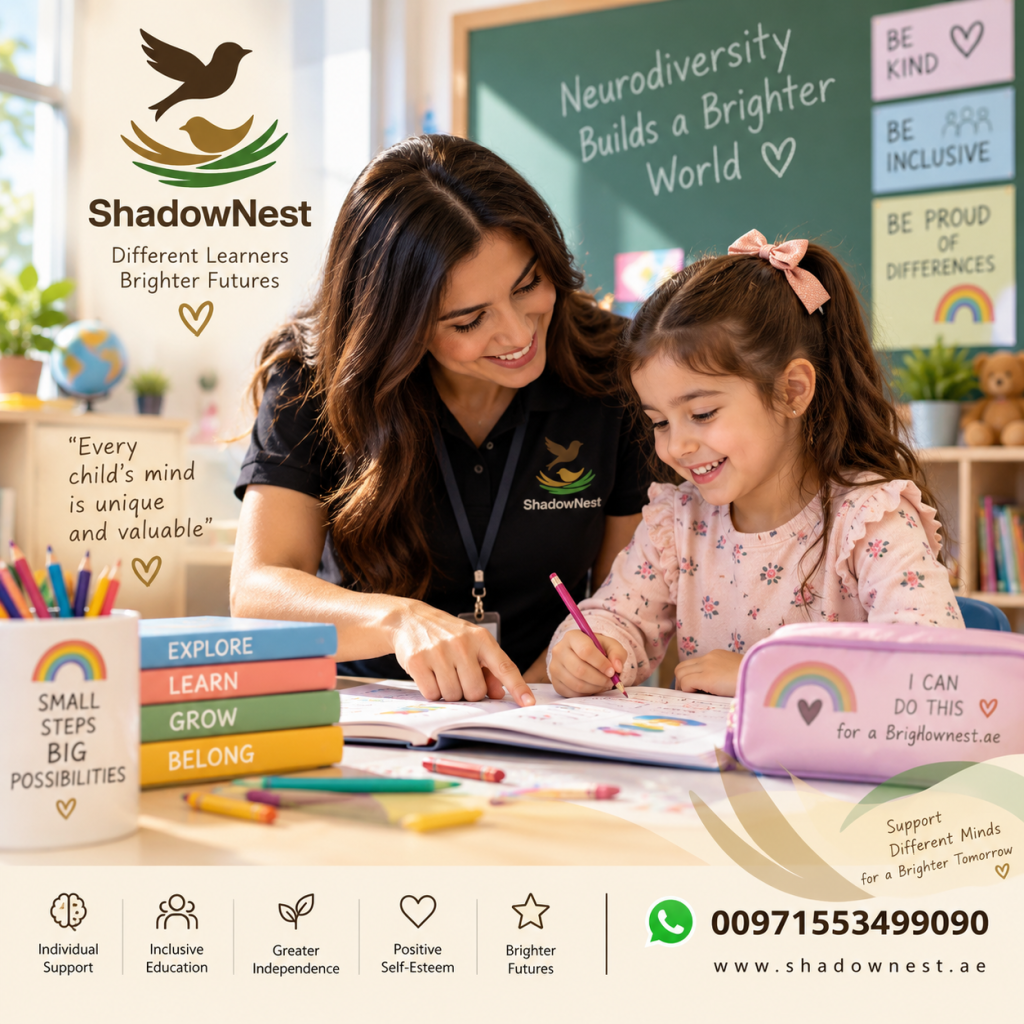
Neurodiversity: 10 Powerful Ways Schools Can Support Different Learners
Every child learns, communicates, behaves, and responds to the world in a different way. Some children may learn quickly through traditional classroom methods, while others may need visual information, movement, additional processing time, structured routines, communication support, or individualized guidance.
This natural variation in how people think, learn, communicate, and experience the world is closely connected to the concept of Neurodiversity.
Neurodiversity encourages us to understand neurological differences as part of human diversity rather than viewing every difference simply as a problem that needs to be eliminated.
For schools, this perspective can be particularly valuable.
A classroom may include children with autism, ADHD, dyslexia, developmental language differences, learning difficulties, sensory differences, and many other individual learning profiles. These children may have significant strengths as well as areas where they need additional support.
The goal should not be to make every child learn in exactly the same way.
The goal should be to create learning environments where different children have meaningful opportunities to learn, participate, communicate, and develop their potential.
This is where Neurodiversity can provide an important framework for schools, teachers, parents, and educational support professionals.
In this article, we explore 10 powerful ways schools can support Neurodiversity and create classrooms that recognize individual strengths while providing appropriate support for children who need it.
What Is Neurodiversity?
Neurodiversity refers to the idea that people naturally have different ways of thinking, learning, communicating, processing information, and experiencing the world.
Human brains are not identical.
People differ in:
- Attention
- Memory
- Communication
- Sensory processing
- Learning
- Emotional regulation
- Social interaction
- Problem-solving
- Executive functioning
- Information processing
Some neurological differences are associated with conditions such as autism, ADHD, dyslexia, and other developmental or learning differences.
The concept of Neurodiversity encourages society to recognize these differences while also acknowledging that some individuals require meaningful support.
This distinction is important.
Recognizing neurological diversity does not mean ignoring genuine difficulties.
A child may have unique strengths while still needing assistance with communication, attention, learning, emotional regulation, or daily school participation.
Good educational support recognizes both sides.
Why Neurodiversity Matters in Schools
Schools traditionally rely on standardized expectations.
Students are often expected to:
- Sit still.
- Listen for extended periods.
- Follow multiple-step instructions.
- Complete written assignments.
- Work at similar speeds.
- Transition quickly.
- Communicate verbally.
- Participate in group activities.
- Organize their own materials.
For many children, these expectations are manageable.
For others, they can create significant barriers.
A child with ADHD may understand the lesson but struggle to maintain attention.
A child with dyslexia may understand a story when listening but struggle to read it independently.
An autistic child may have excellent academic knowledge but find unexpected changes extremely difficult.
A child with language difficulties may know the answer but struggle to express it.
Understanding Neurodiversity allows educators to look beyond the behavior they see and consider the underlying learning profile.
Instead of simply asking:
“Why isn’t this child doing what everyone else is doing?”
educators can ask:
“What does this child need in order to participate successfully?”
That change in perspective can make a major difference.
1. Focus on Strengths as Well as Challenges
One of the most important principles of Neurodiversity is recognizing strengths.
Children with developmental or learning differences are sometimes described primarily in terms of their difficulties.
They may be introduced as:
- The child who cannot concentrate.
- The child who does not speak.
- The child who struggles with reading.
- The child who has behavioral problems.
- The child who needs additional support.
This approach can unintentionally create a negative picture of the child.
Instead, educators should also identify strengths.
A child may demonstrate:
- Excellent memory.
- Strong visual reasoning.
- Creativity.
- Advanced knowledge in a particular area.
- Attention to detail.
- Problem-solving ability.
- Musical ability.
- Strong interests.
- Persistence.
- Excellent visual learning skills.
- Strong empathy.
A child’s strengths can become powerful tools for learning.
For example, if a child is highly interested in animals, teachers can incorporate animals into reading, mathematics, science, communication, and writing activities.
This approach makes learning more meaningful while respecting the child’s individual profile.
2. Understand That Every Neurodivergent Child Is Different
One of the biggest mistakes schools can make is assuming that children with the same diagnosis will have identical needs.
They do not.
Two children with ADHD may have completely different profiles.
One may primarily struggle with attention.
Another may experience significant impulsivity.
One may be academically advanced.
Another may require substantial academic support.
The same applies to autism.
One autistic child may communicate fluently but struggle with social interaction.
Another may use limited spoken language.
One may be extremely sensitive to noise.
Another may actively seek sensory stimulation.
One may have advanced academic abilities.
Another may have significant learning difficulties.
Therefore, Neurodiversity means looking at the individual rather than relying entirely on the diagnosis.
The diagnosis may provide useful information.
But it should not become the complete description of the child.
3. Make Instructions Clear and Predictable
Many children benefit from clear and structured instructions.
This can be particularly helpful for children who experience differences in attention, working memory, language processing, or executive functioning.
Instead of saying:
“Get your books, finish the exercise, check your answers, and then prepare for the next activity.”
a teacher can divide the instruction into smaller steps.
Step 1
Get your book.
Step 2
Open page 20.
Step 3
Complete questions 1–5.
Step 4
Check your answers.
Step 5
Show your teacher.
Breaking information into smaller units can reduce cognitive load.
Visual instructions can provide additional support.
For some children, a simple checklist may be more effective than repeated verbal reminders.
These strategies support Neurodiversity because they allow children to access the same learning environment through methods that better match their individual processing needs.
4. Use Visual Support
Visual information can be extremely useful for many learners.
Examples include:
- Visual schedules.
- Picture instructions.
- Timetables.
- Checklists.
- Timers.
- Written keywords.
- Graphic organizers.
- First-then boards.
- Visual reminders.
- Step-by-step diagrams.
Consider a child who becomes anxious whenever the classroom routine changes.
A visual schedule can show:
Math → Break → Reading → Lunch → Art → Home
If there is a change, the teacher can visually indicate it.
For example:
Math → Assembly → Reading → Lunch
The child can see what is happening rather than relying entirely on verbal explanations.
Visual support does not only benefit autistic children.
It can also help children with ADHD, language difficulties, learning difficulties, executive functioning challenges, and many other learning profiles.
5. Provide Different Ways to Demonstrate Learning
Traditional education often places a strong emphasis on written work.
But writing is not the only way a child can demonstrate knowledge.
Depending on the learning objective, students may sometimes demonstrate understanding through:
- Speaking.
- Drawing.
- Selecting answers.
- Demonstrations.
- Projects.
- Technology.
- Visual presentations.
- Practical activities.
- Structured conversations.
For example, imagine that the learning objective is understanding the life cycle of a butterfly.
One student might write a paragraph.
Another might create a diagram.
Another might explain the process verbally.
Another might arrange pictures in the correct sequence.
If the objective is understanding the concept, the method of demonstrating knowledge can sometimes be flexible.
This does not mean that children should avoid developing difficult skills.
Writing skills still matter.
Reading still matters.
Communication still matters.
The point is that Neurodiversity encourages educators to distinguish between the learning objective and unnecessary barriers that may prevent a child from demonstrating what they know.
6. Support Sensory Differences
Sensory experiences can strongly influence classroom participation.
A typical classroom may contain:
- Loud conversations.
- Chairs moving.
- Bells.
- Bright lights.
- Crowded hallways.
- Strong smells.
- Physical contact.
- Visual distractions.
- Unexpected noises.
For some children, these experiences may be overwhelming.
A child may cover their ears.
Another may become restless.
Another may leave the room.
Another may appear unable to concentrate.
Understanding Neurodiversity encourages schools to consider whether the environment itself is creating unnecessary difficulties.
Possible strategies may include:
- A quieter workspace.
- Planned movement breaks.
- Reduced visual distractions.
- Preparation before noisy activities.
- Access to an agreed sensory strategy.
- Predictable routines.
- Short periods in a calmer environment.
The appropriate strategy depends on the individual child.
There is no universal sensory solution.
7. Teach Executive Functioning Skills
Executive functioning plays an important role in everyday school success.
Children may need support with:
- Planning.
- Organization.
- Working memory.
- Time management.
- Task initiation.
- Task completion.
- Self-monitoring.
- Flexible thinking.
A child may understand exactly what the teacher wants but still be unable to organize the steps required to complete the task.
For example:
“Complete your science project by Friday.”
For an adult, this may sound straightforward.
For some children, however, the task may involve multiple hidden steps:
- Understand the assignment.
- Choose a topic.
- Collect materials.
- Plan the project.
- Start the work.
- Continue working.
- Check progress.
- Complete the final product.
- Submit it.
Breaking large assignments into smaller stages can make them more manageable.
This is particularly relevant when supporting Neurodiversity in mainstream classrooms.
8. Create Opportunities for Movement
Some children find prolonged sitting extremely difficult.
Movement is not always a sign that a child is not learning.
For some learners, appropriate movement can actually support attention and engagement.
Schools can consider:
- Short movement breaks.
- Standing activities.
- Classroom jobs.
- Stretching.
- Movement-based learning.
- Opportunities to change position.
- Active learning tasks.
For example, instead of asking a child to sit through a long lesson without interruption, a teacher may incorporate a short movement activity between tasks.
The goal is not to allow unlimited disruption.
The goal is to create structured opportunities that help the child remain engaged.
A Neurodiversity-informed classroom recognizes that attention and regulation can sometimes be supported through appropriate movement.
9. Teach Social Communication Explicitly
Social communication can be difficult for some children.
They may struggle with:
- Starting conversations.
- Taking turns.
- Understanding personal space.
- Asking for help.
- Joining a group.
- Understanding social cues.
- Interpreting facial expressions.
- Managing disagreements.
- Understanding indirect language.
Adults sometimes assume that children will automatically learn these skills simply by being around other children.
That is not always the case.
Some children benefit from explicit teaching.
For example, a teacher or support professional can teach:
How to join a game
“Can I play with you?”
How to ask for help
“I don’t understand this part.”
How to disagree appropriately
“I think we have a different idea.”
How to enter a conversation
“Can I tell you something?”
These skills can be practiced in real situations.
The purpose is not to force children to behave identically.
It is to give them tools that make social participation easier.
10. Build Independence Through the Right Level of Support
Supporting Neurodiversity does not mean providing maximum adult assistance.
Sometimes too much assistance can actually limit development.
The goal should be the right amount of support.
For example, a child may initially need:
Direct assistance
Later:
Verbal prompting
Then:
Visual prompting
Then:
A brief reminder
Eventually:
Independent performance
This gradual reduction of support can help children develop confidence and independence.
This principle is especially important for shadow teachers.
A shadow teacher should not automatically complete tasks for the child.
Instead, the professional should ask:
“What is the minimum support this child needs to succeed?”
That question can change the entire approach to classroom assistance.
Neurodiversity and Autism
Autism is one of the conditions most frequently discussed in conversations about Neurodiversity.
Autistic children may demonstrate differences in:
- Social communication.
- Sensory processing.
- Repetitive behaviors.
- Flexibility.
- Attention.
- Emotional regulation.
- Communication.
- Social interaction.
However, autism is a spectrum.
There is no single “autistic learning style.”
One child may need substantial communication support.
Another may speak fluently but struggle with social communication.
One child may find noise extremely difficult.
Another may seek sensory stimulation.
One may have significant academic challenges.
Another may perform far above grade level in certain subjects.
Educational support should therefore be individualized.
Neurodiversity and ADHD
ADHD is another important area when discussing Neurodiversity.
Children with ADHD may experience difficulties with:
- Sustained attention.
- Impulse control.
- Organization.
- Working memory.
- Task initiation.
- Task completion.
- Time management.
- Emotional regulation.
However, ADHD can also be associated with strengths such as:
- Creativity.
- Energy.
- Curiosity.
- Spontaneous thinking.
- High engagement with preferred interests.
- Flexible problem-solving.
The educational goal should be to support areas of difficulty without ignoring the child’s strengths.
Classroom strategies may include:
- Shorter task segments.
- Clear instructions.
- Visual reminders.
- Movement opportunities.
- Organizational systems.
- Timers.
- Positive reinforcement.
- Reduced distractions.
- Self-monitoring strategies.
Neurodiversity and Dyslexia
Dyslexia is another area where understanding individual learning differences is important.
A child with dyslexia may have difficulty with:
- Decoding.
- Reading fluency.
- Spelling.
- Phonological processing.
- Written language.
But reading difficulty does not mean that the child lacks intelligence.
A child may have excellent reasoning skills while finding reading significantly more challenging.
Schools can support the child through appropriate evidence-based literacy instruction and reasonable educational accommodations.
Teachers can also ensure that reading difficulties do not prevent the child from accessing knowledge in other areas.
For example, a child may understand a science concept when it is explained verbally even though reading the textbook independently is difficult.
Understanding Neurodiversity helps educators separate intelligence from a specific learning difficulty.
Neurodiversity and Communication Differences
Communication is fundamental to education.
Children communicate through:
- Speech.
- Gestures.
- Facial expressions.
- Writing.
- Pictures.
- Technology.
- Body language.
- Alternative and augmentative communication systems.
Not every child communicates in the same way.
A child with a speech or language disorder may understand much more than they can express.
Another child may speak fluently but have difficulty understanding complex language.
Another may need visual communication.
Schools should therefore consider both receptive and expressive communication.
Teachers can support communication by:
- Giving processing time.
- Using clear language.
- Checking understanding.
- Providing visual information.
- Encouraging appropriate communication methods.
- Collaborating with speech and language professionals.
Communication support can have a direct impact on academic and social participation.
The Role of Parents
Parents play an important role in supporting Neurodiversity.
They often understand their child’s strengths, interests, communication style, and daily challenges better than anyone else.
Parents can help schools understand:
- What motivates their child.
- What situations cause difficulty.
- What strategies work at home.
- How the child communicates.
- What the child enjoys.
- What changes are difficult.
- What goals matter to the family.
However, parents should not be expected to solve every educational challenge themselves.
Effective support requires collaboration between families and schools.
The Role of Teachers
Teachers are at the center of everyday classroom learning.
They can support Neurodiversity by creating flexible and respectful learning environments.
Teachers can:
- Identify individual strengths.
- Use clear instructions.
- Provide visual support.
- Differentiate learning.
- Allow appropriate processing time.
- Encourage peer relationships.
- Support emotional regulation.
- Monitor progress.
- Collaborate with parents.
- Work with support professionals.
Teachers do not need to know everything about every neurological difference.
They do need to be willing to observe, adapt, collaborate, and learn.
The Role of a Shadow Teacher
A shadow teacher can provide individualized support for a child who needs additional assistance to participate successfully in a mainstream classroom.
Depending on the child’s needs, support may include:
- Following classroom instructions.
- Maintaining attention.
- Organizing materials.
- Managing transitions.
- Supporting communication.
- Encouraging peer interaction.
- Supporting emotional regulation.
- Breaking tasks into manageable steps.
- Encouraging independence.
However, a shadow teacher should not become the child’s permanent substitute for the classroom teacher.
The objective should be participation and development.
For example:
Instead of answering every question for the child, the shadow teacher can encourage the child to answer.
Instead of completing a worksheet, the professional can help the child understand the first step.
Instead of constantly reminding the child what to do, the professional can gradually teach the child to use a visual checklist.
This approach is consistent with a more independence-focused understanding of Neurodiversity.
Creating a Neurodiversity-Friendly Classroom
A classroom does not need to be completely redesigned to become more supportive.
Sometimes small changes can have significant effects.
A Neurodiversity-friendly classroom may include:
- Clear routines.
- Visual schedules.
- Flexible seating.
- Predictable transitions.
- Structured group activities.
- Quiet spaces.
- Clear instructions.
- Different ways of demonstrating learning.
- Movement opportunities.
- Positive reinforcement.
- Individualized support.
The objective is not to create a separate classroom for every child.
The objective is to make the existing classroom more flexible.
Neurodiversity and Independence
Independence is one of the most important long-term goals for children receiving additional educational support.
A child should gradually learn to:
- Start tasks.
- Ask for help.
- Manage materials.
- Follow routines.
- Communicate needs.
- Make choices.
- Solve problems.
- Participate socially.
- Manage transitions.
- Advocate for themselves.
This is why support should always have a developmental goal.
The question should not only be:
“How can we help this child today?”
It should also be:
“What skills can we help this child develop for tomorrow?”
That is one of the most powerful principles behind effective support for Neurodiversity.
Neurodiversity Is Not About Lowering Expectations
A common misunderstanding is that recognizing Neurodiversity means lowering expectations.
It does not.
Children should continue to be encouraged to learn, communicate, solve problems, develop skills, and become independent.
The difference is that educators recognize that the pathway may not be identical for every child.
A child may need:
- More processing time.
- Different materials.
- Additional practice.
- Visual support.
- Structured routines.
- Individualized guidance.
Providing these supports does not mean expecting less from the child.
It means giving the child a fair opportunity to demonstrate what they can do.
10 Practical Strategies for Schools
Schools that want to better support Neurodiversity can begin with practical steps.
1. Identify strengths
Understand what each child does well.
2. Identify barriers
Determine what prevents successful participation.
3. Adapt communication
Use clear language and appropriate visual support.
4. Provide predictable routines
Help children understand what will happen next.
5. Offer flexible learning methods
Allow appropriate alternatives for accessing and demonstrating learning.
6. Support sensory needs
Identify environmental factors that create unnecessary difficulty.
7. Teach executive functioning
Help children develop organization, planning, and self-monitoring skills.
8. Encourage social participation
Create meaningful opportunities for peer interaction.
9. Collaborate with families
Parents are important partners in understanding the child.
10. Promote independence
Gradually reduce unnecessary adult assistance.
Common Myths About Neurodiversity
Myth 1: Neurodiversity means that difficulties do not exist
Reality: Neurodiversity recognizes neurological differences while acknowledging that individuals may experience genuine challenges and require support.
Myth 2: Neurodiversity is only about autism
Reality: The concept is broader and is often discussed in relation to autism, ADHD, dyslexia, and other neurological and developmental differences.
Myth 3: Neurodiversity means every child should receive exactly the same education
Reality: Individualized approaches may be necessary because children have different strengths and needs.
Myth 4: Supporting Neurodiversity means lowering academic standards
Reality: Appropriate support can help children access meaningful learning while maintaining appropriate expectations.
Myth 5: A child with a diagnosis automatically needs a shadow teacher
Reality: Support should be based on the child’s functional needs rather than diagnosis alone.
Myth 6: A shadow teacher should stay next to a child every second
Reality: Effective support should be purposeful and should encourage independence whenever possible.
How ShadowNest Approaches Neurodiversity
ShadowNest focuses on individualized classroom support for children with different learning, developmental, communication, attention, behavioral, and emotional needs.
The purpose of a shadow teacher is not simply to remain beside a child.
The support should help the child:
- Participate.
- Communicate.
- Learn.
- Regulate.
- Interact.
- Build confidence.
- Develop independence.
A child should not be defined only by a diagnosis.
Instead, effective support should consider the child’s strengths, challenges, interests, classroom environment, and individual goals.
ShadowNest connects families with trained shadow teachers who provide personalized in-class assistance for children with special educational needs in UAE schools.
Frequently Asked Questions About Neurodiversity
What does Neurodiversity mean?
Neurodiversity describes the natural variation in how human brains function and how people think, learn, communicate, process information, and experience the world.
Is Neurodiversity the same as disability?
No.
Neurodiversity is a broader concept describing neurological variation. Some neurodivergent individuals may also have disabilities or require substantial support.
Which children can be considered neurodivergent?
The term is commonly used in discussions involving autism, ADHD, dyslexia, and other neurological or developmental differences, although terminology and usage can vary.
How can schools support Neurodiversity?
Schools can use individualized teaching strategies, predictable routines, visual supports, flexible learning methods, sensory accommodations, communication support, and opportunities for independence.
Does every neurodivergent child need a shadow teacher?
No.
A child’s actual functional needs should determine whether individualized classroom support is appropriate.
Can a shadow teacher support a neurodivergent child?
Yes. A shadow teacher may provide individualized support with attention, communication, transitions, classroom routines, social interaction, emotional regulation, and task participation.
Can Neurodiversity improve education?
A Neurodiversity-informed approach can encourage schools to recognize individual strengths, reduce unnecessary barriers, and provide more flexible learning opportunities.
Final Thoughts
Neurodiversity reminds us that there is no single way to think, learn, communicate, or experience the world.
A successful classroom does not require every child to be identical.
Instead, it creates enough flexibility for different learners to participate meaningfully.
Some children may need visual schedules.
Some may need movement breaks.
Some may need communication support.
Some may need help with organization.
Some may need individualized classroom assistance.
Others may need very little additional support.
The important point is that educational support should begin with understanding the individual child.
Children should be recognized for their strengths while receiving appropriate help with genuine challenges.
For families and schools, this means moving beyond the question:
“How do we make this child fit the classroom?”
and asking:
“How can we make the classroom work better for this child?”
That is the practical value of understanding Neurodiversity.
And when schools, families, teachers, therapists, and shadow teachers work together, children can have greater opportunities to learn, participate, build relationships, and develop the independence they need for the future.
Real Science, Real Impact
For a deeper understanding of autism, speech-language therapy, and school-based intervention, explore these peer-reviewed articles by Dr. Azizreza Ghasemzadeh:
🔗 Cultural Considerations in the Assessment and Intervention for Autism Disorder
🔗 The Role of Speech Therapy in Enhancing Communication Skills of Children with Exceptional Needs
🔗 Psychosomatic Manifestations in Speech and Language Disorders: A Comprehensive Review
This peer-reviewed paper highlights how cultural awareness and shadow teaching complement each other, especially in diverse communities like Dubai.
Related Topics:
Classroom Support by ShadowNest
Inclusive Education by ShadowNest
shadow teacher in Dubai school
Does my 2 years old need Speech therapy?
How to Request the Best Shadow Teacher in Dubai
If you’re a parent or school administrator seeking expert support, ShadowNest makes the process simple.
👉 Click here to request a Shadow Teacher
Together, we’ll design a support system that works for your child’s unique needs.
Contact ShadowNest
Website: shadownest.ae Phone / WhatsApp: +971 55 349 9090